For co-teaching partners
Plan tomorrow’s co-taught lesson with both teachers fully involved.
Choose the strategy, clarify each teacher’s role, plan for learner needs, and leave with a concrete next step.
Choose your next move
Start with the decision in front of you.
Pick the need that best matches tomorrow’s planning conversation. Each route opens one free reproducible with no email gate.
Strengthen the partnership
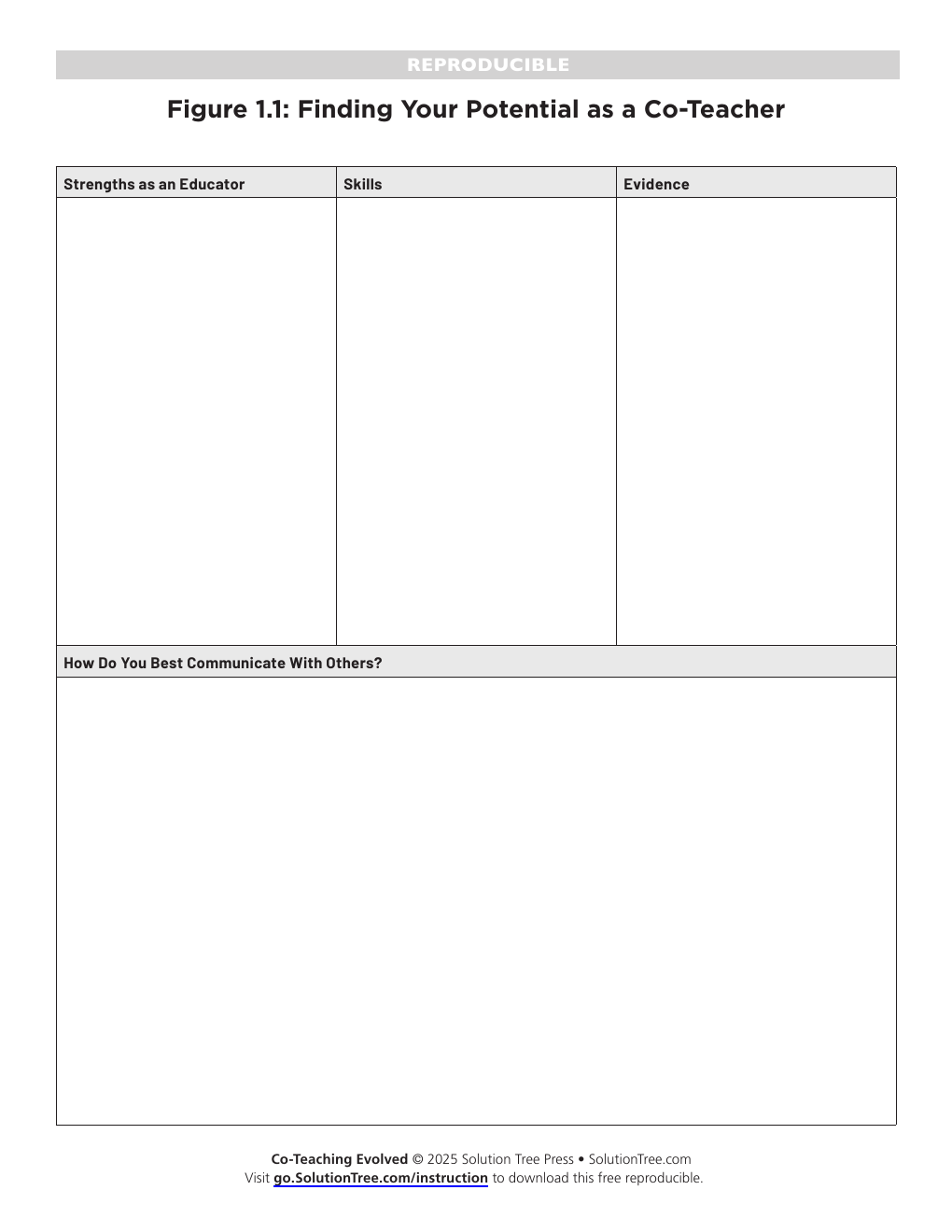
Clarify beliefs, responsibilities, communication, and working expectations.
Choose a strategy
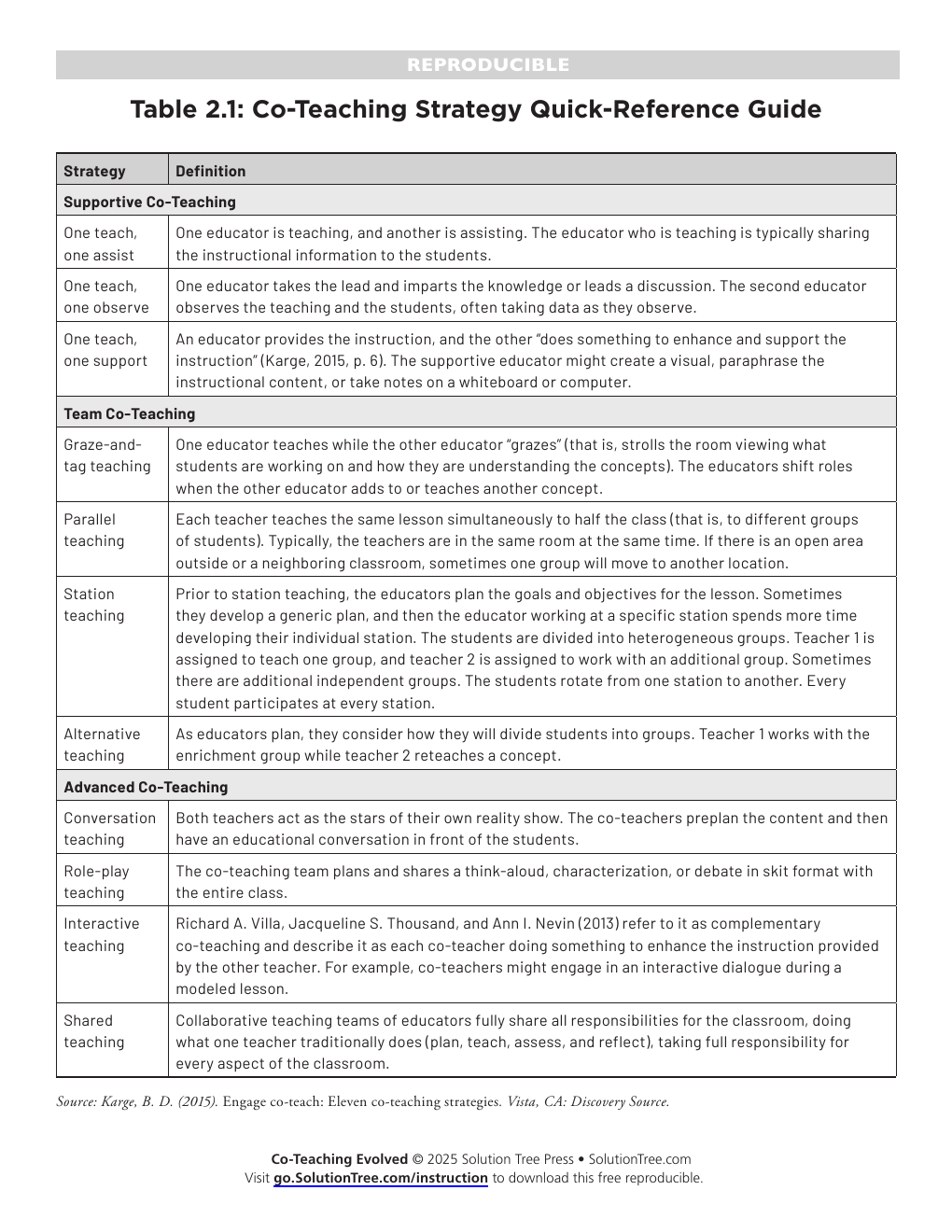
Compare all eleven strategies and select the structure that serves the objective and learners.
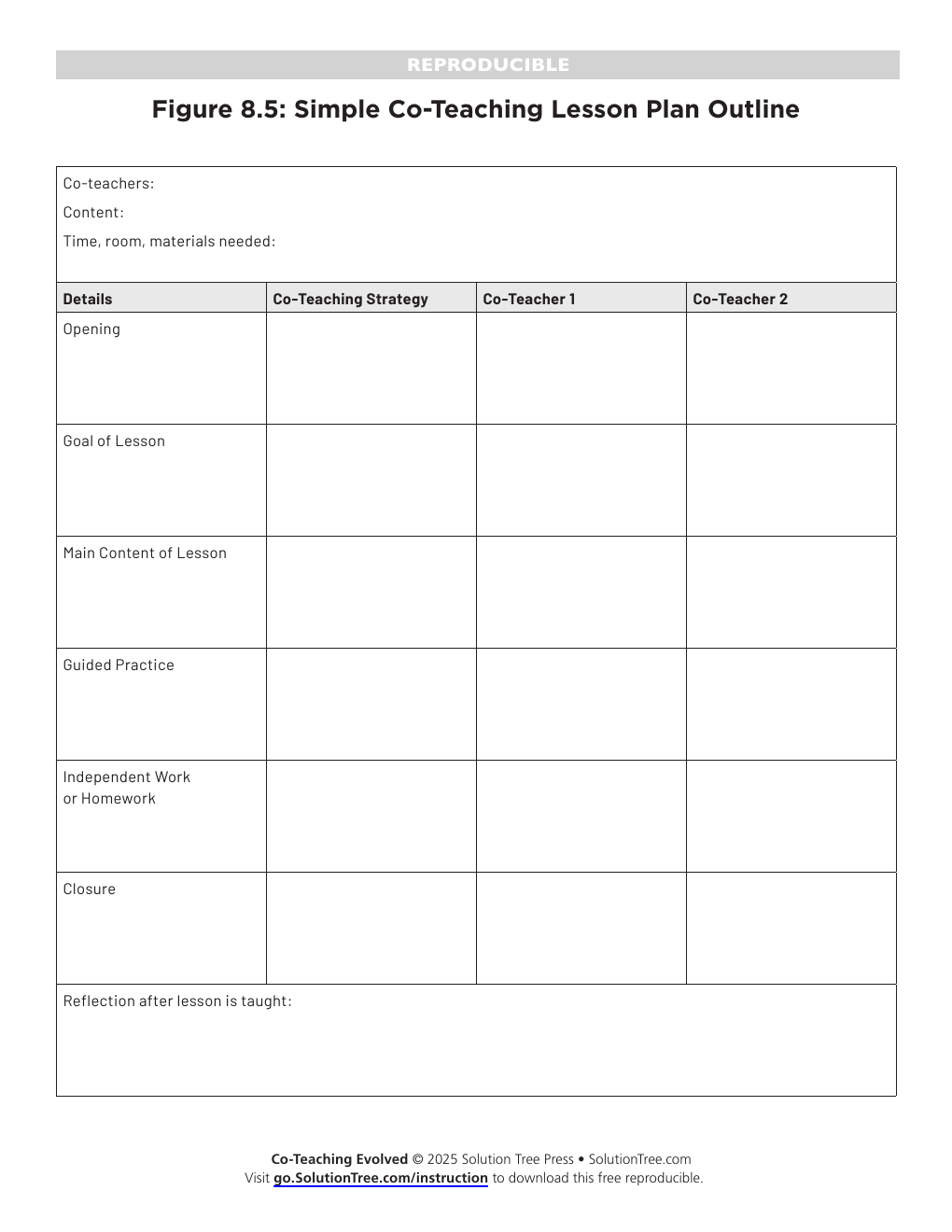
Plan the lesson
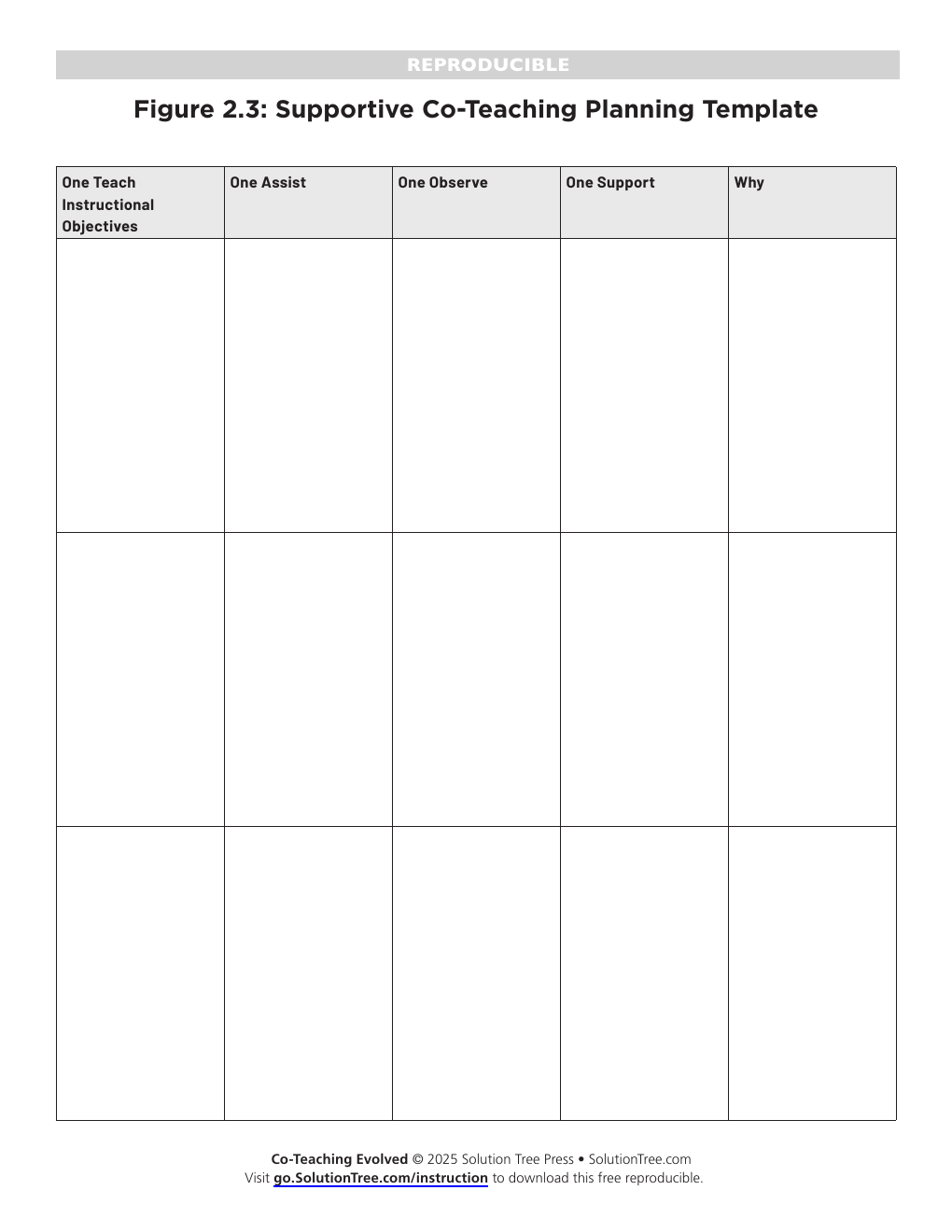
Define the learning goal, practice, teacher roles, closure, and evidence.
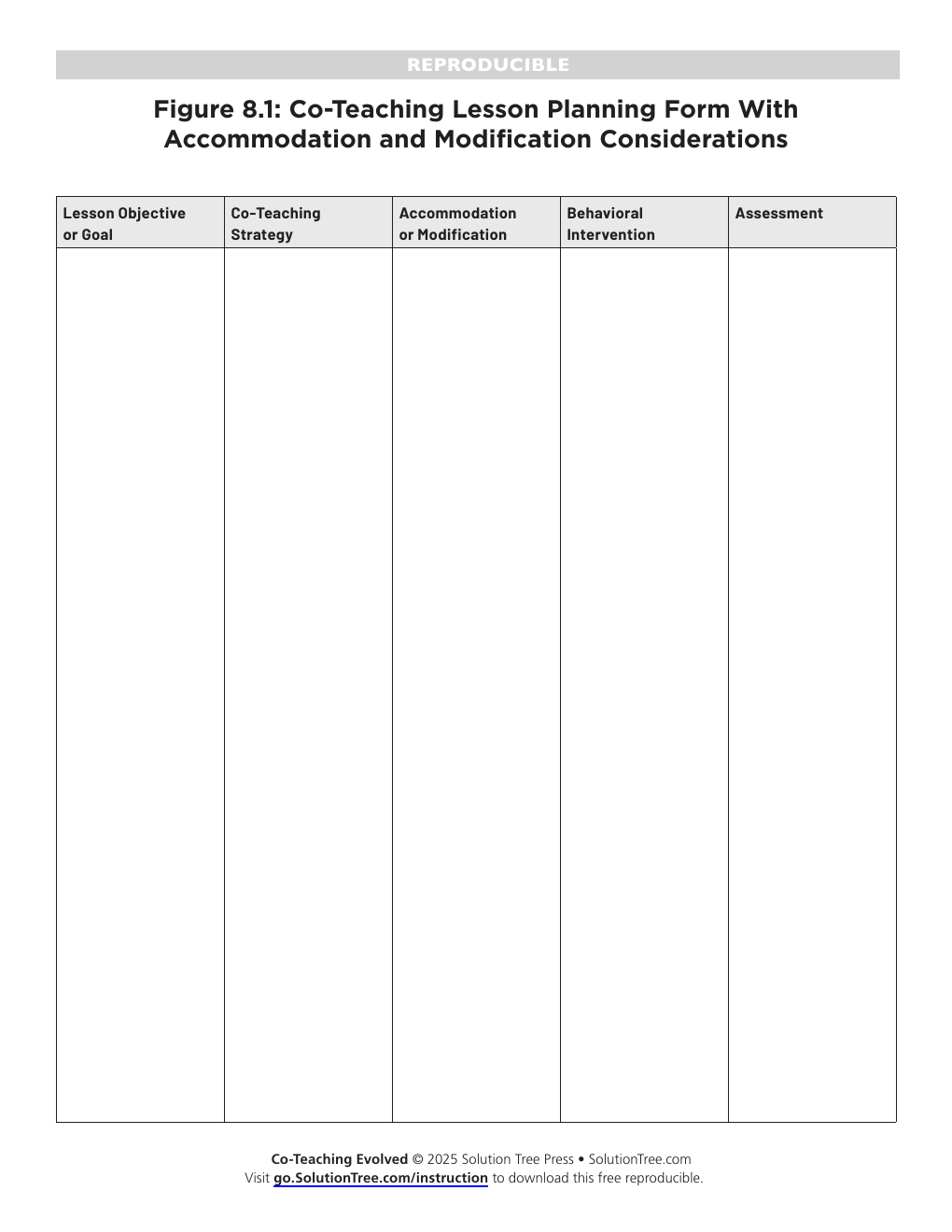
Support specific learners
Connect the lesson to accommodations, modifications, behavior supports, and assessment.
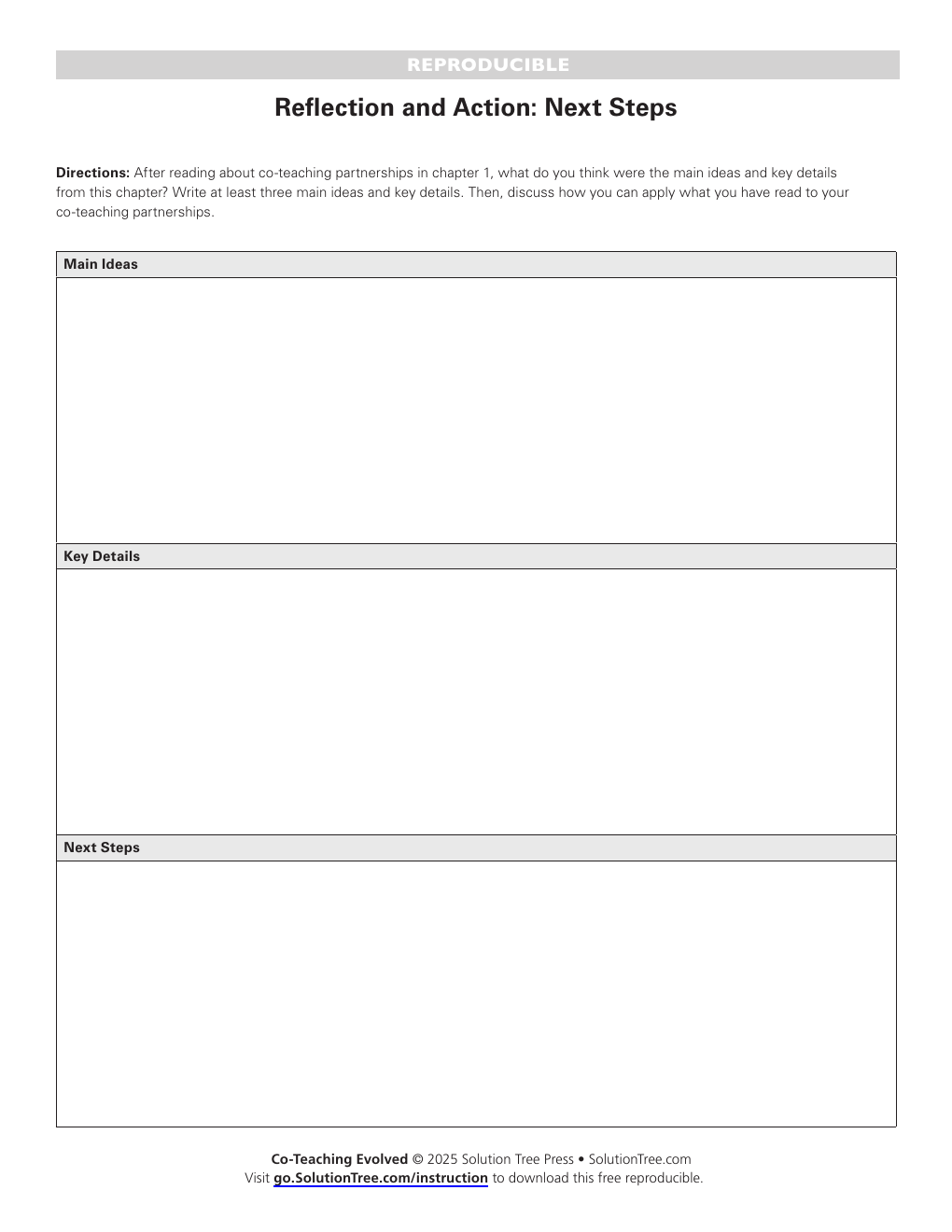
Reflect and improve
Name what worked, what needs attention, and the next partnership move.
A complete lesson cycle
Before, during, and after the lesson.
Before
Agree on the objective and evidence, select the strategy, assign visible roles, and plan learner supports.
During
Use both teachers’ expertise, gather evidence, and adjust grouping, explanation, prompting, or modeling.
After
Compare the intended roles with what happened, review student evidence, and choose one adjustment.
Strategy chooser
Match the structure to the learning need.
Choose after you define the objective, evidence, learners, space, time, and each teacher’s expertise. No single structure is always best.
Focused evidence
Consider: One teach, one observe.
One teacher teaches while the other gathers preselected evidence.
More student talk
Consider: Parallel teaching.
Both teachers teach the same objective to smaller groups.
Multiple tasks or modalities
Consider: Station teaching.
Each teacher leads a purposeful station while students rotate.
A low-preparation bridge
Consider: Graze-and-tag teaching.
One teacher begins while the other tags in to clarify, extend, or model.
Short-term reteaching
Consider: Alternative teaching.
One teacher works with a flexible small group.
Expert dialogue
Consider: Conversation, interactive, or shared teaching.
Both teachers make their thinking visible.
When planning time is limited
Five decisions before class.
For graze-and-tag teaching, agree on natural transition points and a simple tag signal before class.
- What should students know or do?
- What evidence will show whether they learned it?
- Which co-teaching strategy best supports that learning?
- What will each teacher do before, during, and after the lesson?
- What one question will we use to debrief?
Curated teacher toolkit
Six tools teachers can use immediately.
Chapter 2 · 1 page
Co-Teaching Strategy Quick-Reference Guide
Compare all eleven supportive, team, and advanced co-teaching strategies in one concise guide.
Chapter 4 · 1 page
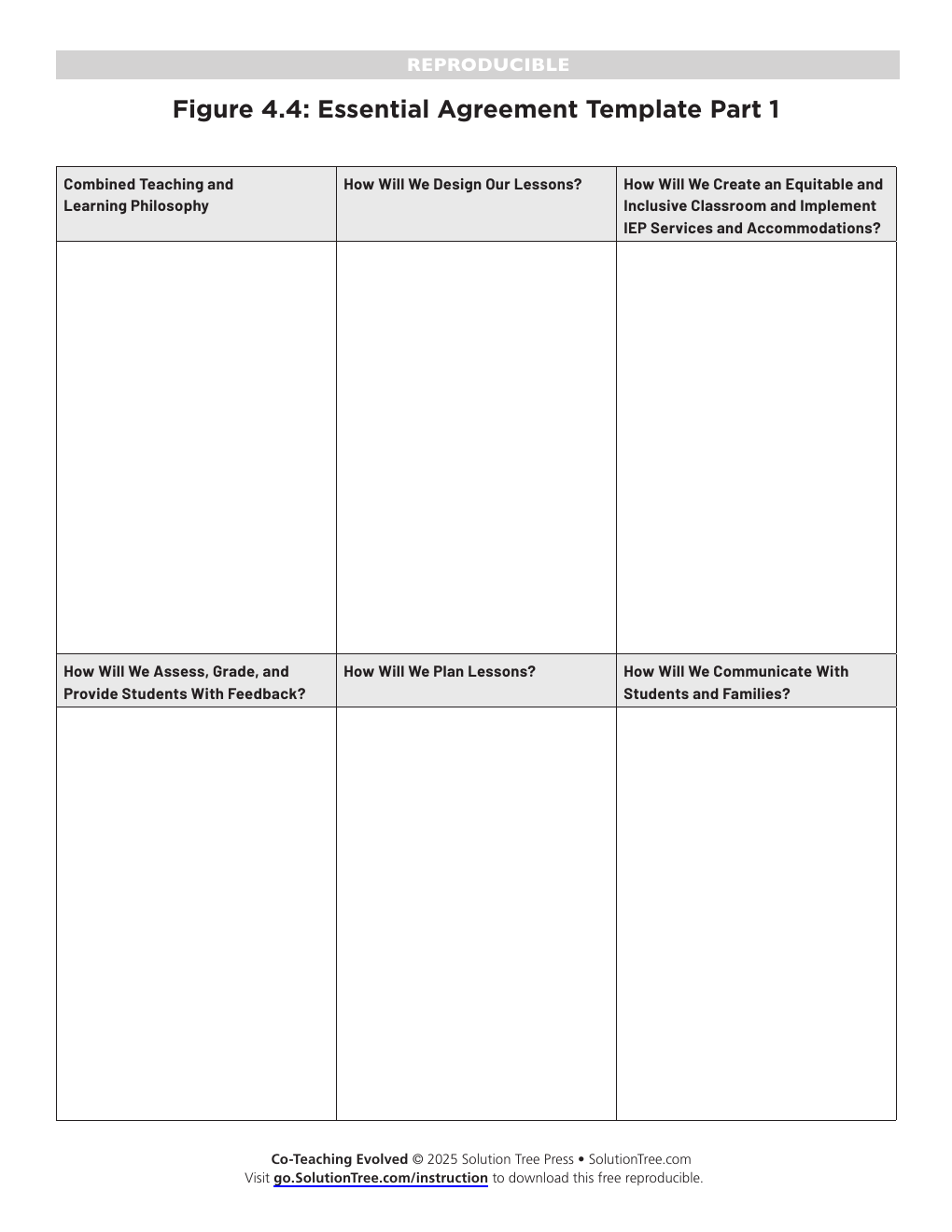
Essential Agreement Template
Agree on lesson design, inclusion, assessment, planning, and communication with students and families.
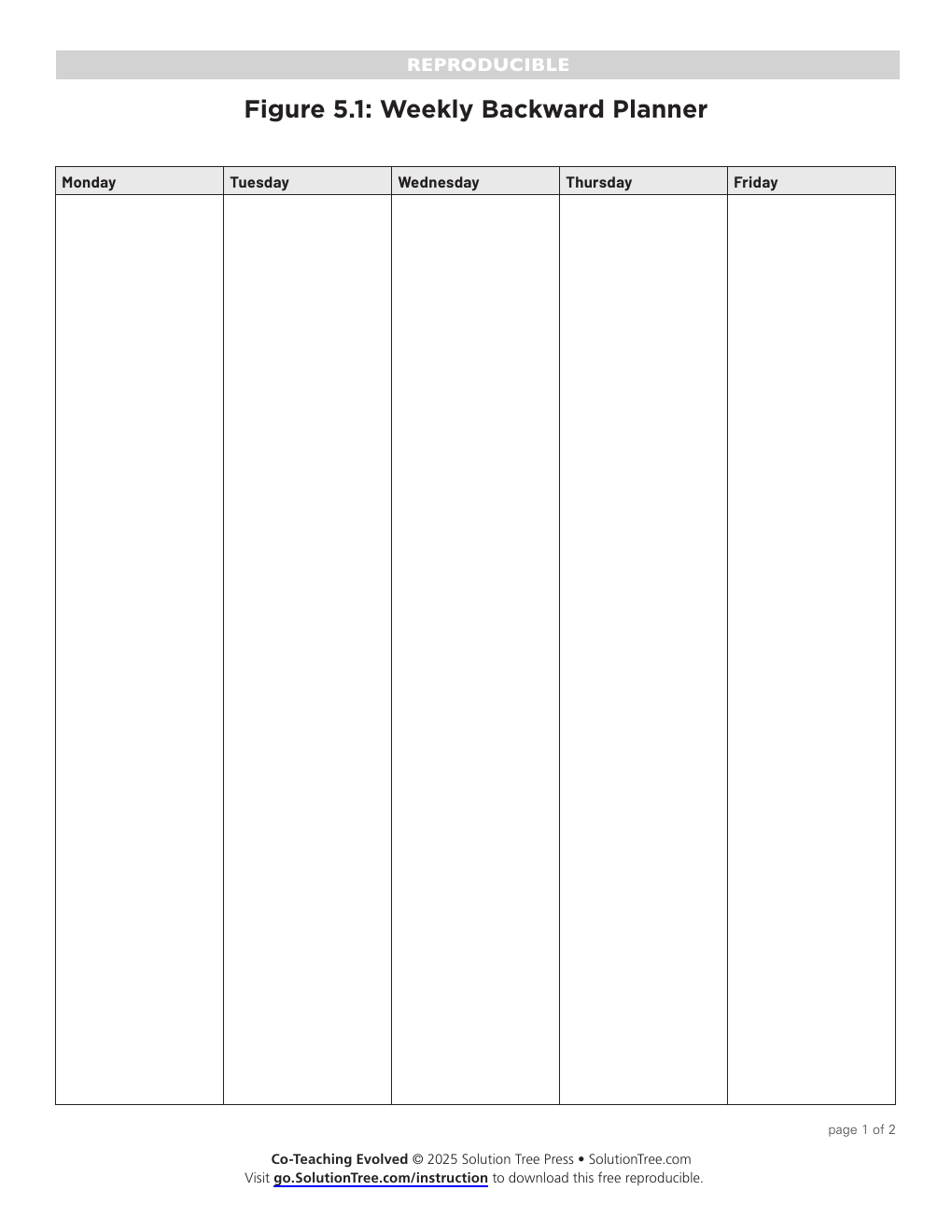
Chapter 5 · 2 pages
Weekly Backward Planner
Work backward across the week from desired learning and evidence to daily instruction.
Chapter 8 · 1 page
Simple Co-Teaching Lesson Plan Outline
Plan the opening, goal, content, practice, independent work, closure, roles, and post-lesson reflection.
Chapter 8 · 1 page
Lesson Planning With Accommodations and Modifications
Connect lesson goals and co-teaching strategy choices to accommodations, modifications, behavior supports, and assessment.
Chapter 1 · 1 page
Reflection: Next Steps
Capture main ideas, key details, and next steps after studying co-teaching partnerships.
Teacher FAQ
Practical answers for common co-teaching decisions.
What if we have little or no shared planning time?
Start with one objective, one evidence check, explicit roles, and a low-preparation structure such as supportive co-teaching or graze-and-tag. Use the Planning Role Breakdown tool to divide preparation without separating responsibility.
Is one teach, one assist always a problem?
No. It becomes weak when the second teacher has no planned instructional purpose. Define who receives support, what the supporting teacher will look for or do, and how the pair will use what they learn.
How do we choose among the eleven strategies?
Begin with the learning objective, student needs, evidence, grouping, space, planning time, and each teacher’s expertise. Choose the structure after those decisions.
Can we change strategies during a lesson?
Yes, when both teachers understand the objective and roles. A planned signal and shared evidence can help the pair shift responsively without confusing students.
How should we debrief?
Review one piece of student evidence, one moment when both roles supported learning, and one adjustment for the next lesson.

