The instructional core
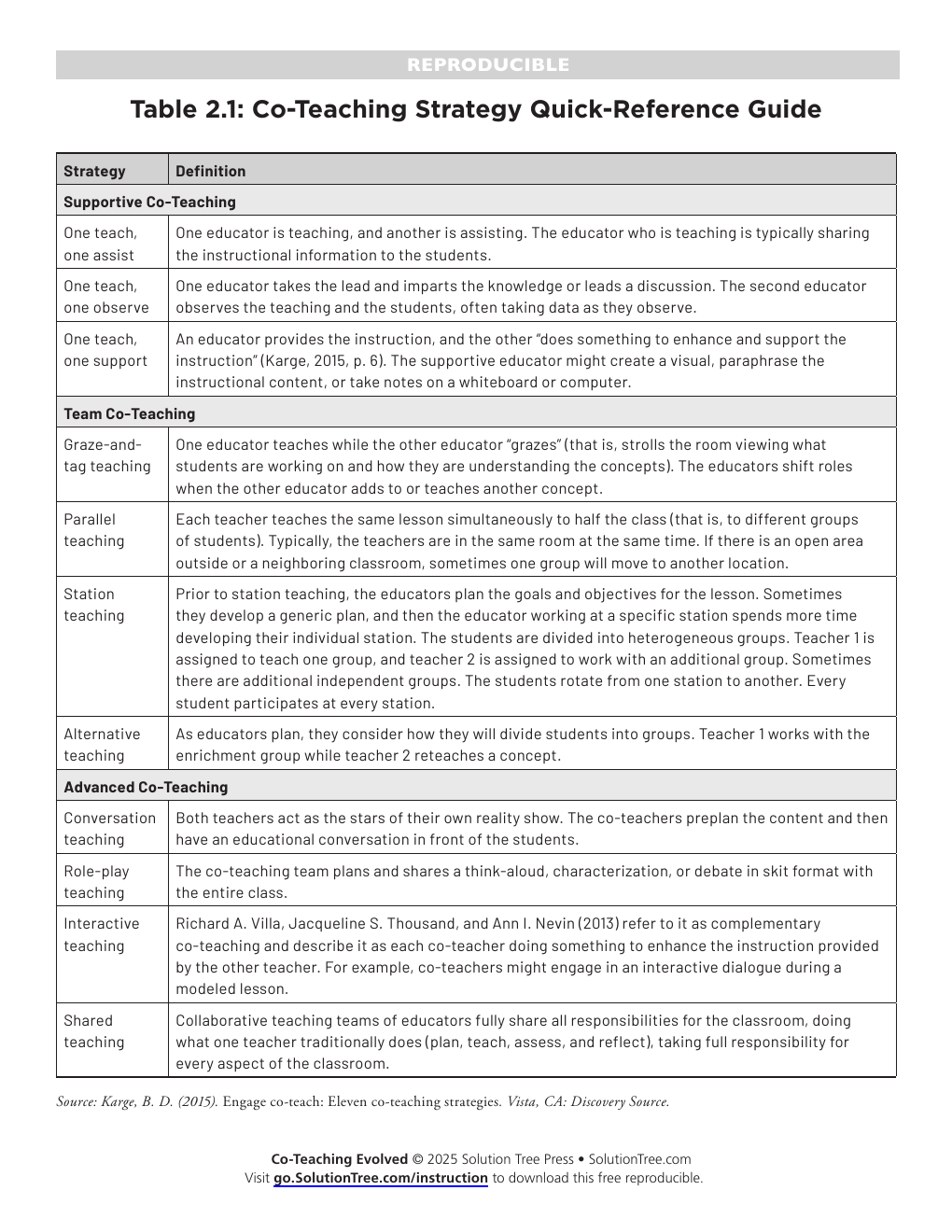
Eleven strategies for purposeful co-teaching.
Move beyond habit. Select the structure that best fits the learning goal, the learners, and what both teachers need to do.
See the strategies in motion
Strategy Video Vault
Pair the overview below with 12 X-and-O-style animated strategy diagrams covering all eleven strategies and a graze-and-tag math example. The videos use symbols, labels, and movement to explain teacher roles and classroom arrangements. They contain no live classroom footage.
$49 one-time · Downloadable MP4 videos · Watch offline
A developmental framework
Start where the partnership is ready, then expand.
The stages are not a ranking of teacher quality. They help partners discuss complexity, shared responsibility, and the structure that will serve a particular lesson.
Supportive co-teaching
One teach, one assist
One teacher leads while the other provides intentionally planned support.
When to use: when students need immediate prompting or clarification
Both teacher roles: Teacher 1 leads; Teacher 2 circulates, prompts, and supports
Classroom example: One teacher models while the other checks first steps
Watch for: Plan when the assisting teacher will lead or gather evidence
One teach, one observe
One teacher teaches while the other gathers preselected evidence.
When to use: when the team needs focused participation or understanding evidence
Both teacher roles: Teacher 1 teaches; Teacher 2 gathers preselected evidence
Classroom example: The observer tracks which prompts increase participation
Watch for: Collect evidence tied to a question the team will use
One teach, one support
One teacher leads while the other delivers targeted supports connected to the objective.
When to use: when learners benefit from visual, paraphrase, notes, or vocabulary support
Both teacher roles: Teacher 1 explains; Teacher 2 makes the explanation accessible
Classroom example: The supporting teacher builds and labels a visual model
Watch for: Agree on the support before class
Team co-teaching
Graze-and-tag teaching
One teacher begins while the other monitors understanding and tags in to clarify or extend.
When to use: when both teachers can contribute through responsive shifts
Both teacher roles: One teacher begins; the other monitors and tags in
Classroom example: A second teacher extends after noticing a common error
Watch for: Use a clear tag cue and purpose
Parallel teaching
Both teachers teach the same objective to smaller groups.
When to use: when students need more discussion, practice, or a lower ratio
Both teacher roles: Both teachers teach the same objective to separate groups
Classroom example: Each teacher guides half the class through the same analysis
Watch for: Align explanations and evidence across groups
Station teaching
Each teacher leads a purposeful station while students rotate.
When to use: when an objective benefits from multiple tasks or modalities
Both teacher roles: Each teacher leads a planned station while students rotate
Classroom example: Students rotate through concept, coached practice, and retrieval
Watch for: Rehearse transitions so movement stays purposeful
Alternative teaching
One teacher leads a flexible small group while the other teaches the larger group.
When to use: when a short-term group needs reteaching, preteaching, or enrichment
Both teacher roles: One teacher teaches the larger group; the other teaches the small group
Classroom example: One teacher preteaches vocabulary while the other extends the task
Watch for: Vary group membership and keep purpose visible
Advanced co-teaching
Conversation teaching
Both teachers model a content-rich academic conversation.
When to use: when students need expert thinking or contrasting interpretations modeled
Both teacher roles: Both teachers preplan a content-rich exchange
Classroom example: Teachers model two evidence-based interpretations
Watch for: Script the exchange so both voices advance the objective
Role-play teaching
Both teachers assume planned roles to make a process or perspective visible.
When to use: when a process, perspective, or misconception becomes clearer when enacted
Both teacher roles: Both teachers assume planned roles
Classroom example: One teacher portrays a policymaker while the other interviews
Watch for: Clarify the learning purpose before adding performance
Interactive teaching
Both teachers alternate complementary explanations, models, questions, and checks.
When to use: when learners benefit from complementary explanations or checks
Both teacher roles: Both teachers alternate planned contributions
Classroom example: One annotates while the other surfaces the decision rule
Watch for: Agree on cues so contributions do not become interruption
Shared teaching
Both teachers share planning, instruction, assessment, and reflection fluidly.
When to use: when a mature partnership is ready to share full responsibility
Both teacher roles: Both teachers move fluidly among teaching, questioning, and assessment
Classroom example: Both launch inquiry, confer, synthesize, and assess
Watch for: Keep shared responsibility visible in planning and debrief

